How to Compare a Business Offer Without Letting the Bonus Decide?
Start evaluating a business software or service offer by writing down the job you need it to do. A welcome credit, gift, or introductory discount can be useful, but it should come after the question of whether the service fits your business.
This guide covers everyday business subscriptions, such as scheduling tools, design software, and customer-management services. It provides a practical comparison process, not financial or legal advice. Use the provider’s current written terms for any real decision.
Define the need before opening the offer
Describe the problem in one sentence. For example, “We need customers to request appointments without exchanging several emails.” Then list the features you actually require, how many people will use the service, and who will maintain it.
Check whether an existing tool can do the job. A new subscription may introduce setup work, duplicate records, or another account to manage. Include the option of keeping your current process in the comparison. If you cannot identify a meaningful operational improvement, set the offer aside until you can.
Separate the service from the incentive
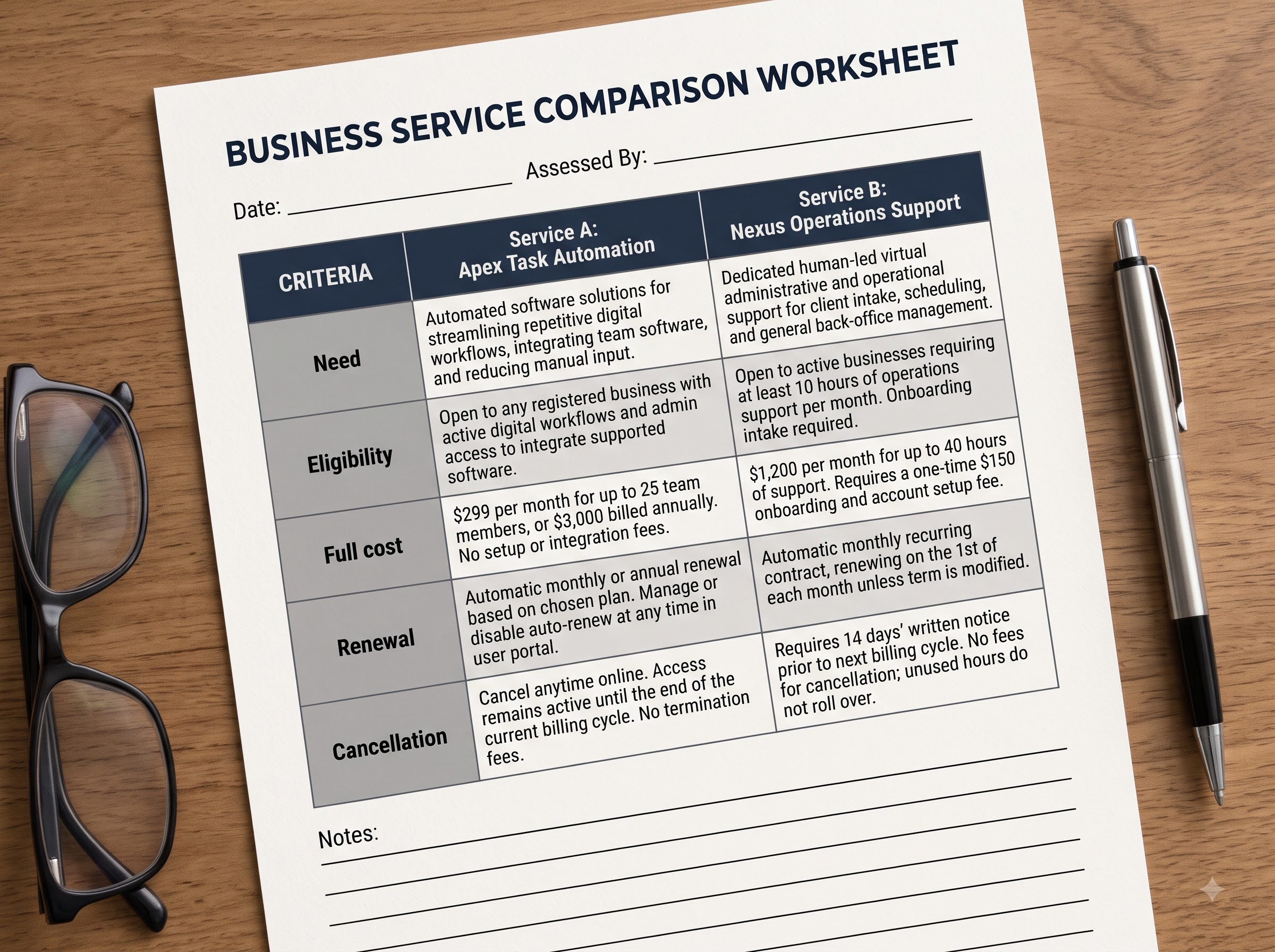
Compare the subscription on its own first. Does the relevant plan include the functions you need? Are there limits on users, usage, storage, support, or integrations? Do not assume a feature shown in a product demonstration is included in the advertised plan.
Then describe the incentive separately. Record its form, stated value, qualifying steps, delivery timing, and any expiration. A service credit is useful only if you can apply it to charges you would otherwise pay. A gift you do not need should not carry the same weight as a reduction in necessary business spending.
Verify eligibility and the required steps
Read the offer terms before starting a trial or entering payment details. Check whether the promotion applies to your business type, location, account history, and chosen plan. Look for enrollment deadlines, minimum commitments, required actions, and exclusions.
Save the terms and the date you reviewed them. If an important condition is unclear, ask the provider for clarification in writing. Leave the incentive out of your calculation until you understand how to qualify. A comparison that depends on an uncertain reward is not ready for a decision.
Compare the cost over the same period
Choose a period that makes sense for the purchase, such as the first twelve months. Record subscription charges, required setup costs, add-ons, and any other stated fees. Check whether an advertised monthly equivalent requires a full year of payment upfront.
Calculate the cost before the incentive, then show the incentive separately. Note when you must pay and when any credit becomes available. Consider staff time for setup, training, and moving information, even if you cannot assign it a precise dollar amount. Repeat the comparison for the next renewal period using the current stated renewal terms.
Work through a simple example
Here is an illustrative example, not a real offer. Assume two scheduling services both meet a business’s required features. Service A costs $40 per month and includes a $100 credit that the business qualifies for and can fully use during the first year. Service B costs $30 per month with no credit. Both are billed monthly, with no setup costs. Taxes and any other fees are excluded from this example.
Service A’s first-year subscription charges are $480 before the credit and $380 after it. Service B costs $360. The advertised $100 incentive still leaves Service A $20 more expensive in year one. If the same monthly prices continue and the credit does not repeat, Service A costs $120 more in year two.
Service A could still be the better choice if it provides a benefit the business values. The comparison simply makes the price difference visible so the bonus does not make the decision for you.
Check renewal and the exit before signing up
Find the renewal date, the price or pricing terms at renewal, and whether renewal is automatic. Check how cancellation works, when notice is due, and what happens to prepaid charges. Also confirm whether you can export the records your business will need if you leave.
Put any review deadline on the calendar before committing. Name the person responsible for checking continued use and handling cancellation if necessary.
Finish with a short decision note: the need being met, the expected cost, the conditions attached to the incentive, and the reason for choosing this service over the alternatives. If the offer still makes sense without the bonus, you have a stronger basis for deciding whether the bonus adds value.
For more practical small business guides, visit blog.businesscardjunction.com.